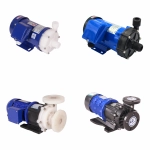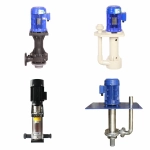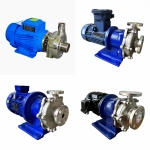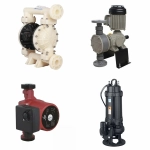
Classification of Chemical Pumps

Views : 830
Author : DUBAO
Update time : 2022-07-02 14:35:25

Types of Chemical Pumps
(1) According to the working principle and structure classification

    1) Vane pump: When the pump shaft rotates, various impeller blades are driven to impart centrifugal force or axial force to the liquid, and the fluid is transported to the pipeline or container, such as a centrifugal pump, vortex pump, mixed flow pump, and axial flow pump.

    2) Positive displacement pump: a pump that uses the continuous change of the volume in the cylinder to transport liquid, such as a reciprocating pump, piston pump, gear pump, or screw pump.

    3) Other forms of pumps: electromagnetic pumps that use electromagnetism to transport liquid electrical conductors; pumps that use fluid energy to transport liquids, such as jet pumps, air lifters, etc.

(2) Classification by Chemical Use
   1) Process pump: including feed pump, return pump, circulation pump, flushing pump, sewage pump, auxiliary pump, output pump, etc.

    2) Public works pumps: including boiler pumps, cooling tower pumps, fire-fighting pumps, deep well pumps for water sources, etc.

    3) Auxiliary pump: including lubricating oil pump, sealing oil pump, hydraulic transmission pump, etc.

    4) Pipeline transfer pump: pump for an oil pipeline, pump for loading and unloading truck, etc.


(3) Classification by Conveying Medium

    1) Water pump: including clean water pump, boiler feed water pump, condensate pump, and hot water pump.

    2) Corrosion-resistant pumps: stainless steel pumps, high-silicon cast iron pumps, ceramic acid-resistant pumps, impermeable graphite pumps, rugged rubber-lined pumps, hard PVC pumps, canned pumps, diaphragm pumps, titanium pumps, etc.

    3) Impurity pump: including slurry pump, sand pump, sewage pump, pulverized coal pump, ash pump, etc.

    4) Oil pump: cold oil pump, hot oil pump, oil slurry pump, liquid hydrocarbon pump, etc. (4) Classification according to the conditions of use 1) Large flow and micro flow pumps: the flow rates are 300m³/min and 0.01L/min respectively;

    2) High-temperature pump and low-temperature pump: high temperature up to 500 ℃, low temperature to -Z53 ℃;

    3) High-pressure pump and low-pressure pump: high pressure up to 200MPa, vacuum degree 2.66---10.66kPa (20—80mmHg);

    4) High-speed pump and low-speed pump: high-speed up to 24000r/min, low-speed 5-10r/min;

    5) Accurate metering pump: the metering accuracy of flow is ±0.3%;

    6) High viscosity pump: the viscosity reaches thousands of Pascals (Pa s).

DUBAO can provide you with all kinds of high-quality chemical pumps with ANSI certification. If you are looking for products with cost-effectiveness, why not contact the experts of DUBAO? Leave us a message now and get the best quotation within the range you pay.

Related News
Read More >>
What is a basket filter and how does it work? What is a basket filter and how does it work?
Oct .19.2024
Basket filter is a commonly used filtration equipment, which is mainly used to remove impurities and suspended matter of larger particles in the liquid to protect the normal operation of downstream equipment and systems
How to improve the operation efficiency of chemical magnetic pump? How to improve the operation efficiency of chemical magnetic pump?
Oct .19.2024
Improving the operational efficiency of chemical magnetic pumps can be achieved through a variety of measures, from optimizing operating conditions to regular maintenance, which can effectively improve the overall performance of the pump
What is the maintenance method of plastic magnetic pump? What is the maintenance method of plastic magnetic pump?
Sep .02.2024
The maintenance of plastic magnetic pumps is essential to extend their service life and ensure safe operation. The following are the common maintenance methods of plastic magnetic pump
What is the working principle of plastic magnetic pump? What is the working principle of plastic magnetic pump?
Sep .02.2024
The working principle of plastic magnetic pump is based on magnetic drive and non-leakage structure, mainly including the following key steps